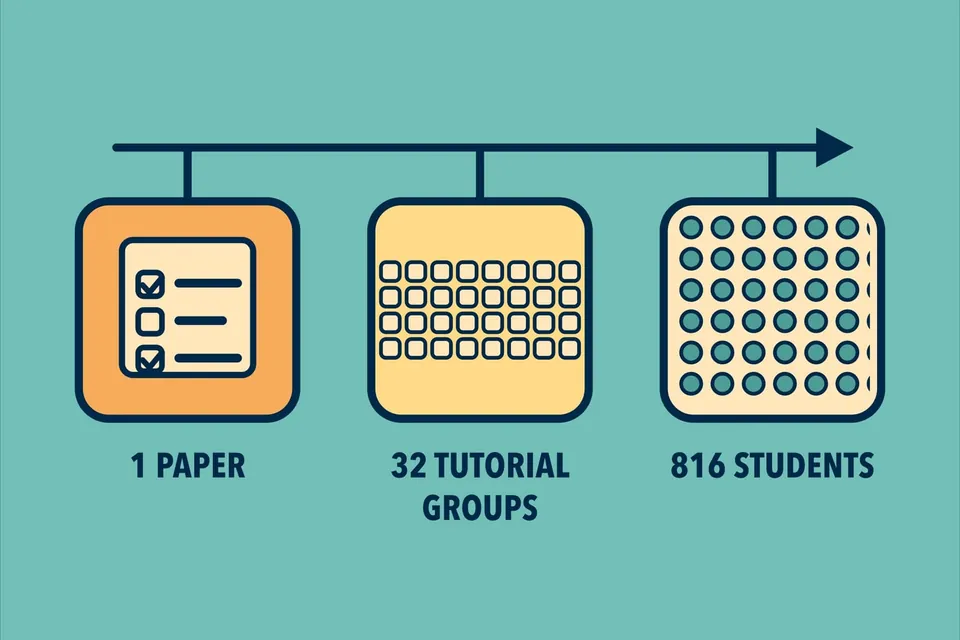
Gianluca Quercini, a lecturer and researcher at CentraleSupélec, decided to end every tutorial session of his course with an MCQ — for a year group of 816 students split across 32 groups. He told the story on July 16, 2026, in an ANSTIA webinar, alongside Aurélie Thomann. This case study reports what was said, with timestamps, and publishes the edited transcript of the session.
What exactly does this webinar show?
It shows one lecturer’s teaching choice for his course — an MCQ at the end of every tutorial session, for a whole year group — and the organization that makes it sustainable for one person. It is neither an audit nor a measurement: everything that follows is self-reported, and sourced to the minute.
ANSTIA × Evalmee webinar — 46 min 58 s — in FrenchComment un enseignant gère le contrôle continu de 800 étudiants seul ?Play the video. Nothing is loaded from YouTube before this click.
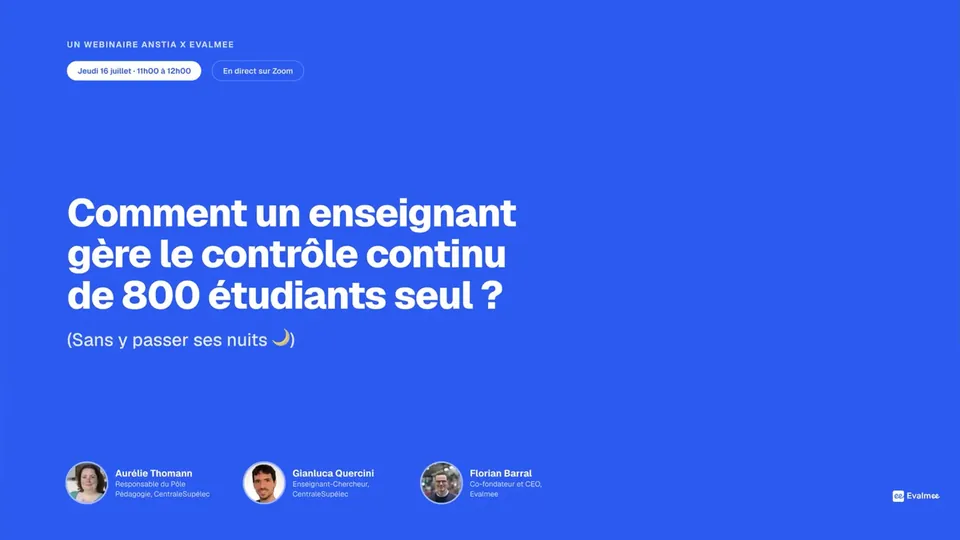
On July 16, 2026, ANSTIA — the French national association of learning technology and audiovisual services in higher education and research — ran a webinar with Evalmee entitled « Comment un enseignant gère le contrôle continu de 800 étudiants seul ? » (How does one lecturer run continuous assessment for 800 students on their own?). Two speakers from CentraleSupélec took part: Aurélie Thomann, head of the teaching innovation unit, and Gianluca Quercini, lecturer and researcher. Florian Barral, co-founder of Evalmee, hosted; ANSTIA chaired the questions. The session, freely available on YouTube, is covered here with timestamps for the important passages, and its edited transcript is published further down — because a readable, quotable text is worth more than a link to 47 minutes of video.
A point of attribution, before anything else. The arrangement described here is Gianluca Quercini’s choice for his course — not an institutional decision. CentraleSupélec is the context: the student numbers, the tutorial groups, the unit that configures exam access arrangements. The tool comes afterwards, as the condition that makes that choice workable for 816 students; the section “What this case does not demonstrate” lists what the webinar leaves open.
Every quotation in this article is translated from French. The webinar was held in French: the original wording is given under each quotation, in French, so that anyone can check it. Where a quotation appears inside a sentence, the French follows it in brackets. In every case the recording is the authority — if this text and the recording differ, the recording is right.
Why did Gianluca Quercini put an MCQ at the end of every tutorial session?
Because, in his course, attendance at tutorials was falling away after the first few sessions, and students were falling back on last-minute studying before the final exam. The end-of-session MCQ is an instrument for regulating work over time, not one more instrument of control.
Gianluca Quercini sets out the observation at 6 min 39 s:
“During the first few tutorial sessions, students came to class. After that they dropped off a bit, and you could see them switching into a mode of ‘we’ll revise for the final exam, and that’s it’. But they were not revising consistently, all through the course, what they had covered in tutorials, and you could see that this had a rather negative impact on their education.”
Original French: « Les élèves, pendant les premières séances de TD, ils venaient en cours. Après ils décrochaient un peu, et on voyait qu’ils se mettaient dans un mode “on va réviser pour l’examen final, c’est tout”. Mais ils ne révisaient pas de manière constante, tout au long du cours, ce qu’ils voyaient en TD, et on voyait que ça avait un impact plutôt négatif sur leur formation. »
“To try to encourage them to follow the course consistently, we decided to put in place a fairly serious form of continuous assessment. That is to say, at every tutorial session, at the end of the session, we always finished with an MCQ of fifteen or twenty minutes.”
Original French: « Pour essayer de les encourager à suivre de manière constante le cours, on a décidé de mettre en place un contrôle continu plutôt sérieux. C’est-à-dire qu’à chaque séance de TD, à la fin de la séance, on terminait toujours avec un QCM d’une quinzaine ou vingtaine de minutes. »
In assessment vocabulary, this is continuous assessmentContinuous assessmentA mode of assessment that spreads grading across several exercises over time rather than concentrating it in a single final exam. It smooths the effect of one poor performance and gives regular measurement points, at the cost of a heavier organizational and grading load.See the full definition serving a goal that research calls the testing effectTesting effectThe phenomenon whereby testing yourself on a piece of content improves your retention of it more durably than rereading it does. Active recall consolidates the memory trace, which makes frequent assessment an instrument of learning in its own right, and not only an instrument of measurement.See the full definition: testing yourself regularly fixes learning better than rereading does. The webinar does not invoke that literature — it describes a teacher’s intuition and the result he expected from it.
The course in question is “Systèmes d’information et programmation”, compulsory for all first-year students (6 min 03 s). The year group numbered 816 students the previous year (6 min 21 s). The webinar’s title rounds this to 800; the exact figure spoken in the video is 816.
The following year, his arrangement moves to 14 tutorial sessions (14 min 43 s), on the same principle.
How does a single lecturer coordinate 32 tutors?
By not putting himself in the middle. The course leader designs and writes the paper, then creates one session per tutorial group; each tutor opens, starts and proctors their own session without him. The course leader steps back in only after the sitting, for the integrity alerts and the export of the grades.
This is the central organizational point of the webinar. Gianluca Quercini describes the constraint at 8 min 36 s:
“Because the course is delivered to the whole year group, the 800 students are not in a single group: they are split across 32 tutorial groups, and so we have 32 different tutors.”
Original French: « Comme le cours est proposé en promotion, les 800 élèves ne sont pas dans un seul groupe : ils sont répartis dans 32 groupes de TD, et donc on a 32 différents intervenants. »
“Being able to divide the students into groups, and to create different sessions for each group, and each session was managed independently by each tutor. So I am not going to step in to activate the MCQ for each tutor: each tutor could do it independently.”
Original French: « Le fait de pouvoir diviser les élèves en groupes, et pour chaque groupe créer des sessions différentes, et chaque session était gérée de manière autonome par chaque chargé de TD. Donc moi je ne vais pas intervenir à activer le QCM pour chaque chargé de TD : chaque chargé de TD pouvait le faire de manière autonome. »
He adds a simple naming convention, at 23 min 35 s: each session is named with the tutorial group number followed by the tutor’s name, so that the tutor spots their own session immediately and sends out the invitations themselves. Students then receive an email containing the link to the MCQ, which stays inactive until the teacher has opened it.
What is left on the course leader’s desk, at 12 min 16 s:
“The only thing I had to do was just, at the end, to look at the integrity reports in the Evalmee interface, to check that there were no suspected cases of cheating. And after that, it was just a matter of retrieving the grades, exporting them to Excel so that I could work out the averages.”
Original French: « La seule chose que je devais faire, c’était juste à la fin de regarder dans l’interface d’Evalmee les rapports d’intégrité, pour vérifier qu’il n’y avait pas de cas suspects de fraude. Et après, il s’agissait juste de récupérer les notes, de les exporter vers Excel pour pouvoir faire les moyennes. »
Asked during the question session about how the authoring work is shared out, he specifies at 39 min 39 s: “For my course, I am the course leader, so I am the one who designs and writes the paper. I do not delegate the creation, but I centralize that task.” [« Pour mon cours, je suis responsable du cours, donc c’est moi qui fais la conception et la rédaction du sujet. Je ne délègue pas la création, mais je centralise cette tâche. »] What is delegated is the running of the sittings, not their content.
On whether this pattern generalizes to other subjects, the answer given in the session stays cautious: a comparable organization is described in physics, whereas in mathematics each group works somewhat differently, with the group leader creating their own papers and sharing them with their tutors. We do not reproduce that passage as a quotation: the recording does not allow those sentences to be attributed to a speaker with certainty.
What was getting in the way with the previous tool?
Four things, described at 7 min 41 s and after: the impossibility of creating separate sessions per tutorial group, an authoring interface that was slow and prone to input errors, no native cheating detection, and a load incident during an assessment sat by the whole year group.
Before Evalmee, Gianluca Quercini used the school’s LMSLMS (learning management system)A platform that hosts an institution's courses, enrollments and learner tracking. It is students' daily point of entry, which makes integration with the LMS — rather than the standalone quality of an exam tool — the practical condition of that tool actually being adopted.See the full definition, a MoodleMoodleAn open-source learning platform, distributed under the GPL license and very widely deployed in French-speaking higher education. Its openness explains why it serves as the reference for integration: an assessment tool that does not plug into it forces teachers to keep two lists of students.See the full definition instance run by Edunao, for two continuous assessments over the year — not one per session. He gives the underlying reason at 8 min 06 s: that tool “is not dedicated to assessment” [« n’est pas dédié à l’évaluation »], it is first and foremost a tool for sharing teaching resources, “that is not its purpose” [« ce n’est pas sa finalité »].
“To create an MCQ — setting aside the design work, but really for the writing — it took me half a day, or maybe even a full day, to check again that everything was set up properly.”
Original French: « Pour la création d’un QCM — si on enlève la conception, mais vraiment pour la rédaction — ça me prenait une demi-journée, voire peut-être une journée aussi, pour revérifier que tout était bien paramétré. »
On integrity, he first points out the absence of any native cheating detection (9 min 49 s), then says at 10 min 10 s that the solution used was a secure exam browserSecure exam browserA dedicated application that replaces the ordinary browser during the exam and locks down the workstation. It offers stronger control than a simple in-browser restriction, but requires an installation, rules out certain devices and shifts part of the technical support burden onto the institution.See the full definition, Safe Exam Browser, and that it was “not flawless” [« pas impeccable »]: students ended up getting round the barriers.
On scale, finally, he recounts at 10 min 33 s a continuous assessment sat by the whole year group where the submission of answers failed: some answers were recorded as temporary, and he had to check the timestamps by hand to make sure that each student’s last answer really was the one taken into account — “a truly enormous amount of work” [« un travail vraiment énorme »], he says, carried out so as not to penalize the students. His conclusion, at 11 min 16 s, is a single sentence: “With Evalmee, I have never had problems of that kind.” [« Avec Evalmee, je n’ai jamais eu de problèmes de ce type. »]
He had summed that contrast up at the very start of the session, at 5 min 14 s, before going into the detail of his course:
“It is a tool that changed my life a little from the point of view of creating exams. […] There are a lot of features, it is a very complete tool, and everything is integrated in the same interface.”
Original French: « C’est un outil qui a changé un peu ma vie d’un point de vue création des examens. […] Il y a beaucoup de fonctionnalités, c’est un outil très complet, et tout est intégré dans la même interface. »
One user’s judgments about his own usage, at a given date — the section “What this case does not demonstrate” comes back to this.
How long does preparing an MCQ take, before and after?
Two orders of magnitude are given, both self-reported. Gianluca Quercini puts writing an MCQ at 10-15 minutes, against half a day to a full day before. Aurélie Thomann puts the review of a paper imported from a PDF at under 5 minutes, against 30 minutes to several hours.
Before
Moodle / Edunao
Writing and re-checking an MCQ: half a day to a full day
of which set-up: around an hour
No session per tutorial group
No native cheating detection
With Evalmee
Continuous assessment, simplified
Writing an MCQ: 10 to 15 minutes
Set-up: immediate
One session per group, opened by the tutor
Integrity reports after every sitting
Durations as Gianluca Quercini gives them for his own course: the half day at 9 min 25 s, the 10 to 15 minutes and the “really immediate” set-up at 11 min 26 s, the absence of a session per group at 8 min 36 s and of native cheating detection at 9 min 49 s. The hour of set-up is the only one that does not come from the recording: he gave it to us after the webinar, as the share of the half day it took him. One user’s estimates of his own tasks, not measurements.
“For writing in Evalmee, it takes a few minutes, 10-15 minutes. The set-up is really immediate, it is very intuitive. There are not too many options, there are just the options you need, and you do not get lost in them.”
Original French: « Pour la rédaction dans Evalmee, ça prend quelques minutes, 10-15 minutes. Le paramétrage, c’est vraiment immédiat, c’est très intuitif. Il n’y a pas trop d’options, il y a juste les options qu’il faut, et on ne s’y perd pas. »
The second comes from a different use case: importing an existing paper. Aurélie Thomann recounts at 35 min 16 s that she tested PDF import on linear algebra and database papers that teachers did not have time to type up themselves, and that she had “very little post-import correction to do” [« très peu de correction post-import à faire »]: the mathematical formulas and the database diagrams present in the original paper had been carried across. Asked about the time saved, she answers at 35 min 57 s:
“In under 5 minutes the paper had been created and checked, whereas […] it takes me a minimum of 30 minutes, and it can run to several hours depending on the level of complexity. And then I am less comfortable with the tech, so I do still struggle a bit with the math formulas, so I triple-check every time.”
Original French: « En moins de 5 minutes le sujet a été créé et vérifié, alors que […] ça me prend minimum 30 minutes, et ça peut aller jusqu’à plusieurs heures étant donné le niveau de complexité. Et puis moi je suis moins familière avec la tech, donc je dois quand même un peu galérer avec les formules de maths, donc je triple-check à chaque fois. »
Gianluca Quercini, for his part, writes his papers in a separate markdown file that he then imports, out of a computer scientist’s habit — and takes care to point out at 33 min 51 s that this detour is not necessary: “You do not have to go through that, I repeat.” [« On n’est pas obligé de passer par là, je le répète. »]
We reproduce these estimates as they stand, with their timestamps, without adding them up into an overall “time saving” that nobody said.
How is exam integrity controlled in the room?
Through three complementary mechanisms, all shown in the demonstration: forced full screen with a live alert when a student leaves it, randomizationRandomizationRandom drawing of questions from a bank and of the order of the options, so that two neighboring candidates do not see the same paper. It is the cheapest defense against copying between candidates; it assumes questions of comparable difficulty if it is to stay fair.See the full definition of the order of questions and options, and a screen recording that can be reviewed afterwards. The webinar is explicit about the limits.
On full-screen exits, at 20 min 09 s: the student’s window goes full screen when the MCQ starts, and any exit is reported immediately in the teacher’s monitoring interface. Gianluca Quercini stresses that most of these alerts are harmless (20 min 43 s):
“Sometimes it is just because of a problem: some students want to check the time, and so they move the mouse up toward the top of the page, and that produces a screen exit. So there we can see straight away whether there is a problem, whether there is an attempt to cheat, or whether it is just a harmless exit.”
Original French: « Parfois c’est juste à cause d’un problème : il y a des élèves qui veulent regarder l’heure, et donc ils vont monter la souris vers le haut de la page, et ça fait une sortie d’écran. Donc là on peut tout de suite voir s’il y a un problème, s’il y a une tentative de fraude, ou si c’est juste une sortie bénigne. »
Hence the instruction given to the tutors, at 26 min 10 s: watch the interface during the sitting and settle cases on the spot, rather than waiting until the end to sort through the alerts. On the MCQ shown in the demonstration, he mentions 17 integrity reports to process (26 min 05 s), including one case where a student’s browser kept crashing and forcing them out of full screen.
Randomization is presented at 19 min 35 s as an answer to physical proximity in the room: a random order of questions and options, so that a glance at the neighboring screen is of no use. The screen recording, triggered by full-screen exits, had not been used on the large year group but had been tested on an end-of-year course (21 min 54 s).
The most important sentence in this section is the one that sets the bounds of the other three, at 27 min 09 s:
“It takes a bit of work afterwards to make sure there has been no cheating, as far as that is possible of course, because 100% security does not exist either when it comes to attempts to cheat in an exam. But at least it makes it possible to have serious, rigorous control.”
Original French: « Ça demande un peu de travail a posteriori pour s’assurer qu’il n’y a pas eu de fraude, dans la mesure du possible bien évidemment, parce que la sécurité 100 %, ça n’existe pas non plus lorsqu’il s’agit de tentative de fraude à l’examen. Mais au moins, ça permet d’avoir un contrôle sérieux et rigoureux. »
How are exam access arrangements handled at this scale?
At institution level, once and for all, and not exam by exam. The teaching unit configures the extra time each student concerned is entitled to; the teacher imports their student list as usual, and the arrangement follows the student without any action on their part.
This is the part of the webinar that has the least to do with the teacher’s convenience and the most to do with fairness. Gianluca Quercini describes it at 17 min 12 s: at the point where the student list is imported at school level — “Aurélie is the one who looks after that side of things” [« c’est Aurélie qui s’occupe de cet aspect »] — extra exam timeTiers-temps (French statutory extra exam time)The extension of exam time granted to a candidate with a disability. The French code de l'éducation provides that it may not exceed a third of the time normally allowed, a longer extension remaining possible exceptionally, on the reasoned request of the doctor who examines the situation.See the full definition and the other exam access arrangementsAménagements d'épreuves (French exam access arrangements)The full set of adaptations available to a candidate with a disability: adapted material conditions, technical and human assistance, spreading exams over several sessions, retention of grades for five years, adapted or waived papers. The authority organizing the exam decides and notifies its decision.See the full definition are attached to the student. Then:
“Every time I import the same student, whatever the course, whatever exam I have set, the student is recognized as being entitled to extra time for their MCQ. And so I have nothing to do, just import the student list as I did for all the others.”
Original French: « À chaque fois que j’importe le même élève, peu importe le cours, l’examen que j’ai fait, l’élève il est reconnu comme ayant droit à un temps supplémentaire pour son QCM. Et donc je n’ai rien à faire, juste importer la liste des élèves comme je l’ai fait pour tous les autres. »
He points out that recognizing the entitlement is a matter for the school — the student declares their situation, provides documentation, the institution validates — and draws the consequence at 19 min 05 s:
“It is set up permanently, and that way we do not risk forgetting a student with a disability. That, too, is very, very important.”
Original French: « C’est paramétré de manière permanente, et de cette manière on ne risque pas d’oublier un élève en situation de handicap. Ça, c’est aussi très très important. »
With 32 groups and around thirty sittings a year, forgetting is not a theoretical hypothesis: it is the most likely failure mode of repeated manual configuration.
What does the webinar say about AI-assisted grading?
Little, but precisely, and about a different course from the one with the continuous assessment. Gianluca Quercini used AI-assisted gradingAI-assisted gradingPre-grading of written answers by a language model, which proposes a grade and a justification that the grader validates, amends or rejects. The decision stays human: what the AI saves is the first pass over the paper, never the responsibility for the grade.See the full definition on open-ended SQL questions in a database course, with a detailed rubric, and systematically validates the result before publishing it.
The continuous assessment MCQs contain no open-ended questions: he says so at 25 min 50 s, “there is no grading, there are no open-ended questions here” [« il n’y a pas de corrections, il n’y a pas de questions ouvertes ici »]. So the use of AI belongs to another course. At 32 min 24 s:
“I had put in a very detailed grading rubric about the student not doing, for example, table joins that are useless. And it worked rather well. I would say that most of the time, most of the grades the AI had proposed, I validated them. And on top of that, sometimes the AI was stricter than I was, because it also managed to detect errors that I had not seen. That allowed me to correct oversights on my part. But I always check what the AI produces.”
Original French: « J’avais mis une grille d’évaluation très détaillée sur le fait que l’élève ne fasse pas, par exemple, des jointures de tables qui sont inutiles. Et ça marchait plutôt bien. Je dirais que la plupart des fois, la plupart des points que l’IA avait proposés, je les avais validés. Et en plus, parfois l’IA était plus sévère que moi, parce qu’elle arrivait à détecter aussi des erreurs que moi je n’avais pas vues. Ça m’a permis de corriger des oublis de ma part. Mais je vérifie toujours le rendu de l’IA. »
Two things are worth noting. First: it is the rubricRubricA grid crossing assessment criteria with performance levels described in full sentences, from the weakest to the strongest. The grader places the paper in a cell rather than awarding a figure: the grade becomes the consequence of a description shared in advance.See the full definition that does the work — the AI does not invent the criteria, it applies them. Second: the teacher stays in the loop, and he gives a reason for that which is not technical but educational — being assessed by a machine alone, he says in substance, is not satisfactory for the student. That is also how our grading page describes it working: proposed grades, human validation.
What institutional context does this course sit in?
Aurélie Thomann, who leads on this subject on the school’s side, gives the overall figures at the opening: a deployment started in 2020 with 200 students, today more than 4,000 students a year sitting one or more exams, and more than 45,000 grades generated annually across all formats. Gianluca Quercini’s continuous assessment is one usage among that whole, not the framework prescribed to him.
At 2 min 32 s, she introduces herself and sets the scene:
“I am head of the teaching innovation unit at CentraleSupélec. We are a small team of three learning designers, and we have been working with Evalmee since 2020, post-pandemic, when we had carried out a review of our remote exam solution that led us to step up a gear.”
Original French: « Je suis responsable du pôle d’innovation pédagogique à CentraleSupélec. On est une petite équipe de trois ingénieurs pédagogiques, et on travaille avec Evalmee depuis 2020, post-pandémie, où on avait fait un bilan de notre solution d’examen à distance qui nous avait conduit à changer de braquet. »
Then, at 2 min 57 s: “At first with small numbers: we started with 200 students, and now we have more than 4,000 students sitting one or more exams on Evalmee per year.” [« D’abord sur des petits effectifs : on a commencé avec 200 élèves, et maintenant on a plus de 4 000 étudiants qui passent un ou plusieurs examens sur Evalmee par an. »]
The uses have broadened along with the volume (3 min 16 s): final exams to begin with, then continuous assessment, then admission tests for Bachelor and Master of Science type programs. Hence the total announced at 3 min 36 s: “That generates an absolutely staggering number of grades per year, if you aggregate all those exam formats. So more than 45,000.” [« Ça génère un nombre de notes absolument faramineux par an, si on agrège tous ces formats d’examen. Donc plus de 45 000. »]
Two further reference points complete the picture: a first-year engineering year group is approaching 900 students (3 min 52 s), and the teaching staff numbers around 300 permanent members and several hundred hourly-paid lecturers, with a core of around 230 teachers who use the tool independently (4 min 00 s).
That last figure is the most interesting one for anyone considering a deployment: 230 independent teachers is the outcome of support work carried out by a three-person teaching team, not an automatic effect of installing a piece of software.
What this case does not demonstrate
An honest piece of evidence also says what it does not prove. Five limits are worth stating, and they are not stylistic caveats.
No measured effect on learning. The arrangement was put in place to improve attendance and regularity of work. The webinar presents no before/after comparison of results, no attendance rate, no average grade. The educational intent is documented; its effect is not.
The durations are self-reported. Half a day against 10-15 minutes, 30 minutes against 5 minutes: these are users’ estimates about their own tasks, not measurements. They indicate an order of magnitude, not a ratio to be taken as it stands.
The comparison is about one usage, not about two products. What is described of the school’s LMS is one teacher’s experience in a given configuration, at a given date. Another institution, another instance, another version could yield another account.
One case does not make a method. CentraleSupélec has a dedicated teaching team, a core of trained teachers and a course leader who centralizes the authoring. Remove one of the three and the organization described here no longer holds in the same way.
This is not an institutional decision. Nothing in the webinar says that CentraleSupélec imposes, recommends or generalizes this mode of continuous assessment. Asked during the session about other subjects, the speakers describe practices that differ from one department to another. What the school provides is a framework — student numbers, groups, a deployed tool, a unit that configures exam access arrangements; the arrangement described here remains one lecturer’s choice for his course.
Edited transcript of the webinar
What follows is an edited transcript of the session, in the order of the video. It was produced from the automatic subtitles published by YouTube, then cleaned up: hesitations and repetitions removed, punctuation added, proper nouns restored. No substantive word has been added, and passages whose automatic transcription was too degraded to be reliable are summarized in brackets rather than reproduced.
The video is the authority. Where this text and the recording differ, the recording is what is true — open the replay on YouTube to check any timestamp below, or go back to the player at the top of the article.
Every timestamp in this article is clickable, here and in the sections above: each one opens the video at that exact moment, in a new tab.
0 min 00 s — Opening (Florian Barral, Evalmee)
Presentation of the running order: CentraleSupélec’s context by Aurélie Thomann, then the experience report and demonstration by Gianluca Quercini, then questions. The subject is announced from the outset: a lecturer running more than 800 students across a whole year group, with a quiz at every session and around thirty tutors to coordinate.
2 min 29 s — CentraleSupélec’s context (Aurélie Thomann)
Head of the teaching innovation unit, leading a team of three learning designers (2 min 32 s). Working with Evalmee since 2020, following a post-pandemic review of the school’s remote exam solution. Started with 200 students; more than 4,000 students a year today, on one or more exams (2 min 57 s).
The uses have evolved (3 min 16 s): final exams first, then continuous assessment, then admission tests for Bachelor or Master of Science type programs. Total: more than 45,000 grades a year (3 min 36 s), across sessions ranging from a few dozen to several hundred students. A first-year engineering year group is approaching 900 (3 min 52 s).
Around 300 permanent teaching staff, several hundred hourly-paid lecturers, and a core of around 230 teachers who work independently (4 min 00 s). The teaching unit continues to train and support new users.
4 min 51 s — The course and the problem (Gianluca Quercini)
A user since 2020: one of his first remote exams was sat on Evalmee. At 5 min 14 s he says the tool “changed my life a little” [« changé un peu ma vie »] from the point of view of creating exams, describes it as “very complete” [« très complet »] and notes that everything is integrated in the same interface. A lecturer and researcher, he leads the course “Systèmes d’information et programmation”, compulsory in the first year (6 min 03 s). The year group numbered 816 students the previous year (6 min 21 s).
The observation, at 6 min 39 s: students came to the first tutorial sessions then dropped off, saving themselves for the final exam, with no regular work — and an effect judged negative on their education. Hence the decision, at 7 min 06 s, to run a “fairly serious” form of continuous assessment: a fifteen to twenty minute MCQ at the end of every tutorial session.
7 min 41 s — What was getting in the way before (Gianluca Quercini)
Previously, two continuous assessments over the year on the school’s Moodle, operated by Edunao. Four difficulties:
The tool’s purpose (8 min 06 s). An LMS is there first of all to share teaching resources; assessment is not its purpose, and not all of the functions expected of an assessment tool are present.
Sessions per group (8 min 36 s). The 800 students are split across 32 tutorial groups with 32 tutors; creating a separate session per group was not possible.
Authoring (9 min 25 s). An interface judged too cluttered, a risk of ticking the wrong answer, and half a day to a full day to write and re-check an MCQ.
Integrity and scale (9 min 49 s). No native cheating detection; Safe Exam Browser judged “not impeccable” and got round by students (10 min 10 s). During an assessment sat by the whole year group (10 min 33 s), the submission of answers failed and some answers were recorded as temporary, forcing a manual check of the timestamps so as not to penalize students.
No incident of that kind since. Authoring in 10 to 15 minutes, “really immediate” set-up and few options (11 min 26 s). The feature cited as decisive, at 11 min 56 s: dividing students into groups and creating one session per group, each session then being managed independently by the tutor concerned. The course leader no longer has to activate the MCQs.
What remains his responsibility (12 min 16 s): reading the integrity reports at the end of the sitting and exporting the grades to a spreadsheet where the averages are already set up.
13 min 16 s — Demonstration: organization and authoring (Gianluca Quercini)
Filing exams in folders and sub-folders, useful as the number of sittings grows — one tutorial session, one MCQ, sometimes duplicated because the half-year groups do not sit it on the same day; 14 sessions planned for the following year (14 min 43 s).
The editor makes it possible to write and proofread the paper, to write formulas, code and rich text, and to preview the result with the correct answers displayed — a visual check which, he says, reduces the risk of having ticked the wrong answer.
17 min 03 s — Setting up the paper (Gianluca Quercini)
MCQ duration with an individual countdown: a student who arrives late still gets their twenty minutes, and answers are submitted automatically when the time is up. Time arrangements configured at school level and attached to the student (17 min 12 s), and therefore applied without any action from the teacher, whatever the course — a permanent setting which, he says at 19 min 05 s, keeps a disabled student from being forgotten. Free navigation between questions, which he enables systematically because students appreciate being able to go back over their answers. Random order of questions and options (19 min 35 s). Built-in calculator, useful in mathematics.
20 min 02 s — Monitoring and anti-cheating (Gianluca Quercini)
Full screen at start-up (20 min 09 s), live notification in the teacher’s interface on exit, red alert screen on the student’s side. Many exits are harmless (20 min 43 s) — a mouse movement toward the top of the screen to check the time — and students often come and explain them of their own accord after the sitting. Screen recording on exit, tested on an end-of-year course and not on the large year group (21 min 54 s). Blocking of spellcheckers, which can also trigger a screen exit.
22 min 58 s — Sessions, invitations and tracking (Gianluca Quercini)
Each student belongs to a tutorial group; one session is created per group, named by group number and tutor name (23 min 35 s). The tutor sends out the invitations themselves the day before: an email containing the link to the MCQ, inactive until they have opened it. Sixteen groups for half-year-group tutorials, 32 for whole-year-group MCQs. He also says that a duplicated exam carries its sessions with it, which avoids having to redo that split for every sitting.
During the sitting, activity can be filtered by group, so each teacher need only monitor their own.
25 min 41 s — Results and integrity reports (Gianluca Quercini)
No grading as such: the MCQ contains no open-ended questions (25 min 50 s). List of students and grades, then integrity reports — 17 to process in the example shown (26 min 05 s), including one case where a student’s browser was crashing and forcing them out of full screen. Instruction to tutors, at 26 min 10 s: deal with alerts during the sitting rather than afterwards. Simple export of the grades, or detailed export when a grading scheme has to be revisited or a question removed after the fact.
On cheating, the position is explicit (27 min 09 s): some verification work remains, total security does not exist, but the arrangement allows serious, rigorous control.
28 min 13 s — Preview, simulation, question removal (Gianluca Quercini and Florian Barral)
Preview of the paper as the student will see it, and a real-exam simulation making it possible to check that the settings — random order, duration, screen recording — work as intended. Florian Barral flags a function added since: removing a question directly in the tool and recalculating the grades, without going back through the spreadsheet. Gianluca Quercini discovers it during the session.
30 min 40 s — Creating an exam and AI grading (Gianluca Quercini)
Creating a paper from the interface: question types, multiple choice, open-ended questions. For an open-ended question, a grading rubric can be filled in; it guides the automatic grading by the AI, with the teacher then checking that it complies with the rubric. A model answer can be supplied and made visible to the student after the sitting.
Real usage described on a database course, for SQL questions, with a detailed rubric penalizing useless joins in particular (32 min 24 s). The result judged rather good, most of the grades proposed validated, the AI sometimes detecting errors the teacher had not seen. Systematic checking of the output, including for what a student is entitled to expect from an assessment.
33 min 12 s — Markdown import and file import (Gianluca Quercini, Florian Barral, Aurélie Thomann)
Gianluca Quercini writes his papers in a markdown file that he then imports, out of a computer scientist’s habit, pointing out at 33 min 51 s that this detour is not compulsory. Florian Barral presents file import, which accepts an existing document with no particular syntax.
Aurélie Thomann recounts testing it (35 min 16 s) on linear algebra and database papers sent in as PDFs by teachers: very few corrections after import, mathematical formulas recognized and diagrams extracted. Paper created and checked in under five minutes, against a minimum of thirty minutes and sometimes several hours before (35 min 57 s). She adds that the structure of the paper — exercises and questions — is recognized, and that a check is still needed.
37 min 31 s — Audience questions (chaired by ANSTIA)
Who writes the MCQs? For his course, Gianluca Quercini is the course leader and handles both design and writing himself: he does not delegate the creation, he centralizes it (39 min 39 s). In other subjects, practices differ — a comparable organization is mentioned in physics, a group-by-group arrangement in mathematics.
Can student names be hidden during a presentation? Yes: displaying names is toggled in the interface. The question came from an attendee who said they were already using Evalmee.
What does the solution cost? An answer was given in the session on the principle of a license per student giving access to an unlimited number of assessments and teachers, with volume discounts. We do not reproduce the amounts quoted: they do not match the offer published today.
Thanks to the three speakers and announcement that the session would be made available as a replay.
Frequently asked questions
How many students does this continuous assessment cover?
Gianluca Quercini states at 6 min 21 s that the year group taking his Systèmes d’information et programmation course numbered 816 students the previous year. Those students are split across 32 tutorial groups, led by 32 different tutors, and the MCQ is sat by the whole year group at once.
Can a single lecturer really run continuous assessment on this scale?
In this particular case, yes, on one condition made explicit in the webinar: the lecturer does not proctor the sittings. He designs and writes the paper and creates one session per tutorial group, then each tutor opens and proctors their own session independently. The course leader only takes over again at the end, for the integrity reports and the export of the grades.
Does the webinar give a quantified time saving?
It gives two orders of magnitude, both of them self-reported and not measured by any protocol. Gianluca Quercini puts writing an MCQ at half a day or even a full day with his previous tool, against 10 to 15 minutes with Evalmee. Aurélie Thomann puts the review of a paper imported from a PDF at under 5 minutes, against 30 minutes to several hours before.
How is cheating dealt with during these MCQs?
Through full-screen exits flagged live in the monitoring interface, a random order of questions and options, and a screen recording triggered when a student leaves full screen. Gianluca Quercini makes clear that total security does not exist and speaks of serious, rigorous control rather than of a guarantee.
What does the webinar say about AI-assisted grading?
Gianluca Quercini used it on open-ended SQL questions in a database course, with a detailed grading rubric. He validates most of the grades it proposes, notes that the AI was sometimes stricter than he was because it also picked up errors he had not seen, and stresses that he always checks its output.